
Quick Answer
Usually not by ear: in controlled studies people identify AI voices correctly only about 60% of the time and mistake clones for the real person roughly 80% of the time. Software detectors analyzing acoustic fingerprints do better, but reliable consumer tools remain scarce in 2026 — McAfee’s Deepfake Detector (launched August 2024, ~90% claimed accuracy, on-device) is the most mainstream option. Your best defense is process: a family safe word and calling back on a known number.
Short answer: Usually not — at least not by ear. In controlled studies, people correctly identify an AI-generated voice only about 60% of the time, barely better than a coin flip, and they mistake a cloned voice for the real person roughly 80% of the time. Software detectors do better by analyzing acoustic fingerprints humans can’t hear, but reliable consumer tools are still scarce in 2026. The practical takeaway: don’t trust your ears on a suspicious call — use process defenses like a family safe word and calling back on a known number.
Can Humans Tell an AI Voice from a Real One?
No — not reliably. This is the single most important finding from recent research, and it should change how you treat any unexpected voice call.
A 2025 study by Sarah Barrington and Hany Farid at UC Berkeley, published in Scientific Reports, tested people with state-of-the-art voice clones. Participants judged an AI-generated voice to be the same person as its real counterpart 80% of the time, and when asked directly whether a voice was real or AI-generated, they were right only about 60% of the time. Short clips under 20 seconds — the length of a typical scam voicemail — were the hardest to judge. (PubMed: Barrington & Farid, 2025)
Other studies agree. UCL researchers found 70% accuracy distinguishing real from AI voices, and brief training on what to listen for barely helped. A Lancaster University study landed at 53.95% — essentially chance. The consistent message from researchers: human ears are not a detection tool. If your defense plan is “I’d be able to tell,” the data says you probably wouldn’t.
Why Do AI Voices Fool Us So Easily?
Because the cues we trust most — emotion, pauses, breathing — are exactly what modern voice models have learned to reproduce.
People listen for robotic flatness or odd pauses, heuristics that worked against older text-to-speech. Today’s cloning models are trained on natural conversational speech, so they reproduce hesitations, laughter, and emotional tone convincingly. One study concluded that authenticity judgments based on these vocal cues are now unreliable, because the cues themselves are replicable by synthesis systems.
One exception matters: familiarity helps. UCL’s Carolyn McGettigan found people were much better at catching deepfakes when listening to a voice they knew well, like a family member’s. A stranger’s voice gives your brain nothing to compare against. And context cuts the other way — in a calm lab with full attention, participants still failed; in a real panic-driven scam call, performance can only be worse.
How Does Audio Deepfake Detection Actually Work?
Detectors don’t listen for meaning — they scan for the acoustic fingerprints that synthesis leaves behind.
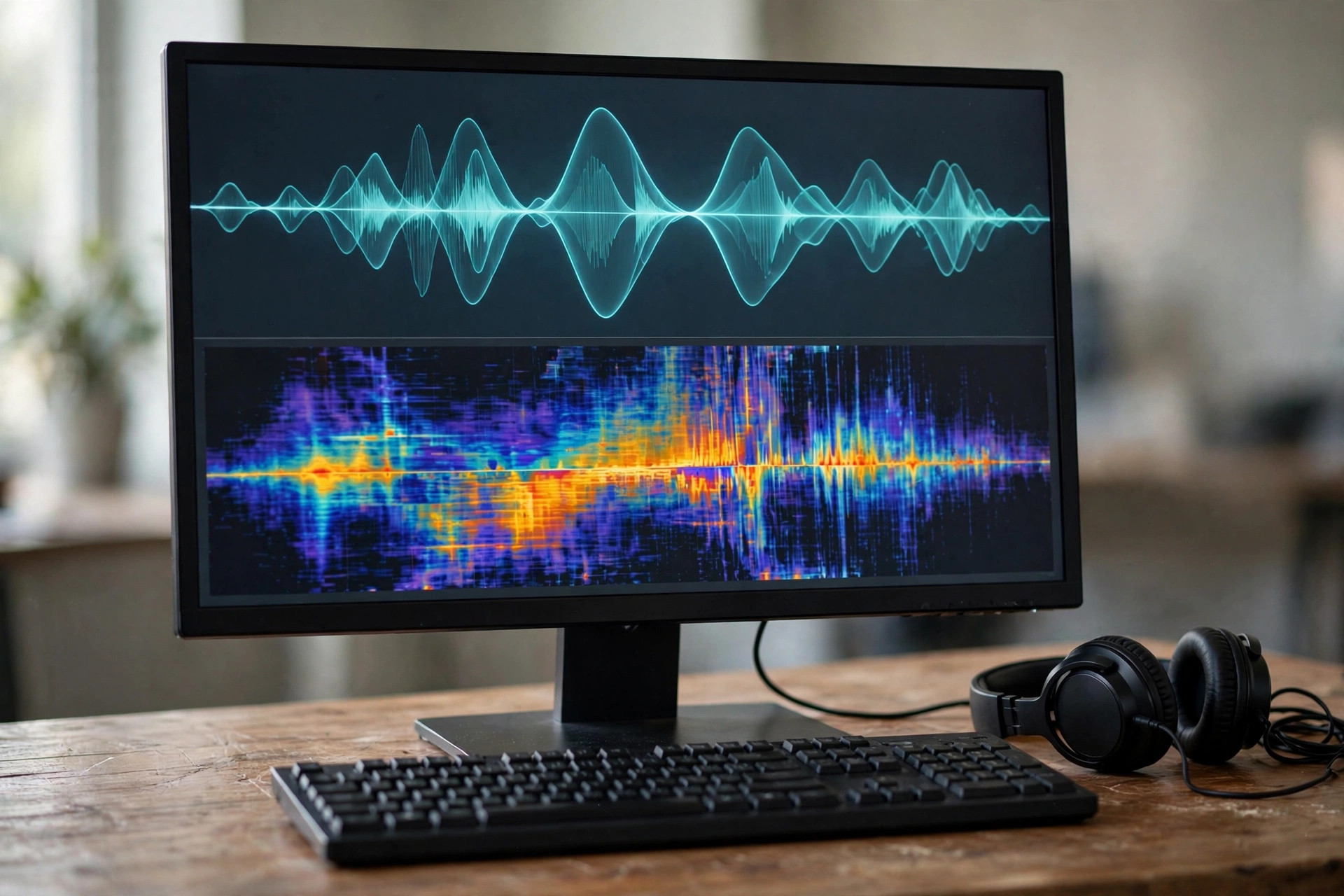
Every AI voice generator builds sound through a neural vocoder, leaving subtle statistical traces: unnatural high-frequency patterns, phase inconsistencies, artifacts from training data. Human ears gloss over these; a trained classifier doesn’t. Detection models learn from large datasets of real and synthetic speech and output a probability — “likely AI-generated” — rather than a yes/no verdict.
Two consequences follow. First, detection is inherently probabilistic, like AI text detectors — there is no 100% verdict. (The same caution about false positives that surrounds AI text detection in education applies here; see our student guide to AI checks and academic integrity.) Second, it’s an arms race: every improvement in voice generation erodes the artifacts detectors rely on, so models need constant retraining. Researchers also stress that analyzing a recording is far easier than judging a live call in real time — which is why process defenses matter more than any app.
What AI Voice Detection Tools Exist in 2026?
Honest answer: far fewer consumer options than the threat deserves. The strongest tools are enterprise products or bundled security features, not standalone apps you can point at a suspicious voicemail.
McAfee Deepfake Detector is the most mainstream consumer option. Launched in August 2024 (unveiled as “Project Mockingbird” at CES 2024), it automatically monitors audio in videos playing on your PC and alerts you within seconds if the audio appears AI-generated. Detection runs locally on the device’s NPU — McAfee says it stores neither your audio nor browsing history — and at launch the company claimed around 90% accuracy. Two caveats: it’s bundled with McAfee+ plans rather than sold standalone, and it analyzes audio only, not video. (McAfee Deepfake Detector)
Reality Defender is the leading specialist platform, but it’s built for enterprises and developers. The New York company — named Most Innovative Company at the RSA Innovation Sandbox, with backing from Accenture Ventures — uses a multi-model approach across audio, image, video, and text. Its lineup includes RealCall for call-center voice fraud and RealMeeting plugins for Zoom and Teams. Developers can use a detection API with a free tier (50 detections per month) — the closest thing to a free, legitimate testing option currently available. (Fast Company)
If you’re hoping for a free “Shazam for AI voices” app — we couldn’t verify any reliable one. Treat apps making that claim with skepticism, and never upload sensitive voice recordings to an unvetted tool.
The Case That Changed Everything: The Fake Biden Robocall
The most consequential AI voice deepfake to date wasn’t a scam — it was election interference, and it ended in criminal charges.
Two days before New Hampshire’s January 2024 primary, thousands of voters got a robocall in what sounded exactly like President Joe Biden’s voice, urging them to skip the primary. The voice was AI-generated: political consultant Steve Kramer had commissioned the call, and the audio was produced with ElevenLabs’ voice cloning platform — then available for as little as $5 a month.
The fallout was real: the FCC proposed a $6 million fine against Kramer, and New Hampshire prosecutors brought criminal charges including voter suppression and impersonating a candidate. Then, on February 8, 2024, the FCC unanimously ruled that AI-generated voices in robocalls are illegal under the Telephone Consumer Protection Act — making the cloned voice itself a violation, not just the scam behind it. (Nextgov)
The case proved two things: a convincing voice clone can be made cheaply by a non-expert, and deploying one carries genuine legal risk. The technology outran the law for a while; the law is catching up.
How Can You Protect Yourself from AI Voice Scams?
Stop trying to detect the voice. Detect the situation instead.
Since neither ears nor apps are reliable in the moment, researchers recommend process defenses — habits that work no matter how good the clone is:
- Set a family safe word. Hany Farid’s top recommendation: agree on a secret passcode with family now, and ask for it on any unexpected urgent call. A scammer with a cloned voice won’t know it.
- Hang up and call back. If “your daughter” calls from an unknown number in trouble, hang up and call her real number. A real emergency survives two minutes of verification; a scam doesn’t.
- Treat urgency plus secrecy as the red flag. “Don’t tell mom,” “act in 10 minutes,” “pay in gift cards” — scammers manufacture panic because panic shuts down verification. Slow down deliberately.
- For suspicious videos, check provenance. Our guide to AI watermarking and content credentials walks through the free verification tools, and our deepfake spotting guide covers the visual side.
Warn the people around you, too: studies find overconfidence is part of the vulnerability — people who believe they’d spot a fake are less likely to verify. A two-minute conversation about the safe word beats any detector app.
The Limits: Why Voice Detection Will Never Be Perfect
Detection is probabilistic, adversarial, and always one step behind generation — so a clean result proves nothing.
Three limits to keep in mind. First, every detector has false-positive and false-negative rates, and vendors’ accuracy claims come from their own test sets, not independent audits. Second, it’s an arms race: detectors trained on today’s voice models degrade as generators improve. Third, coverage is incomplete — as with AI watermarking, the absence of a detection signal is weak evidence. “No AI detected” means the tool found nothing, not that the audio is human.
The most promising long-term direction is provenance at creation: Google’s SynthID already watermarks AI-generated audio, and OpenAI has added SynthID watermarking to audio from its platform — deterministic signals that don’t depend on statistical guessing. Until that coverage is universal, assume any unexpected voice could be synthetic, and verify through a second channel.
FAQ
Can AI detectors detect an AI-generated voice?
Specialized audio deepfake detectors can, with meaningful but imperfect accuracy. But general-purpose “AI detectors” built for text cannot analyze voice at all — you need an audio-specific tool, and even those give probabilities, not certainties.
Is there a free AI voice detector I can use?
There is no widely available free consumer app we can recommend for checking a suspicious recording — be wary of apps claiming to do this, and don’t upload sensitive audio to unvetted tools. The legitimate free option is Reality Defender’s developer API free tier (50 detections per month), which needs some technical setup.
How much audio does someone need to clone my voice?
Very little. Modern tools can build a convincing clone from a few minutes of clear speech — the Biden robocall audio was made with an off-the-shelf $5/month cloning service. Assume anything you’ve posted publicly is enough source material.
What should I do if I get a suspicious call from a “family member”?
Hang up and call them back on their real number, and ask for your family safe word. Don’t send money or gift cards, and don’t keep the call secret at the caller’s request. If money was already sent, contact your bank and local police immediately.
Are AI voices in robocalls illegal?
In the US, yes. The FCC ruled in February 2024 that AI-generated voices in robocalls violate the Telephone Consumer Protection Act. The New Hampshire Biden deepfake case drew a proposed $6 million FCC fine plus state criminal charges.
Can my employer detect an AI-generated voice?
Possibly, if they use enterprise detection tools — call centers and some institutions deploy voice-fraud detection. But detection is probabilistic and policies vary. Don’t rely on “they can’t prove it” as a strategy.
Common Questions About AI Voice Clones
Can you tell an AI voice clone from a real voice?
Not reliably by ear: a 2025 UC Berkeley study by Sarah Barrington and Hany Farid, published in Scientific Reports, found people correctly identified state-of-the-art voice clones only about 60% of the time — barely better than chance — and mistook clones for the real person roughly 80% of the time. If you think you’d spot a fake, the research says you are probably overconfident — and overconfidence reduces verification.
What AI voice detection tools exist in 2026?
Fewer consumer options than the threat deserves: McAfee Deepfake Detector is the most mainstream, monitoring audio in PC videos with on-device NPU analysis and alerting within seconds at a claimed ~90% accuracy — but it is bundled with McAfee+ plans, not sold standalone, and analyzes audio only. Reality Defender leads the specialist enterprise side; reliable standalone consumer apps remain scarce.
What should I do if I get a suspicious voice call?
Hang up and verify through a separate channel: the article’s core advice is to use a family safe word for emergencies and always call back on a known number, because a real emergency survives two minutes of verification while a scam does not. Treat urgency plus secrecy — ‘don’t tell mom,’ ‘act in 10 minutes’ — as the red flag it is.
Why will voice detection never be perfect?
Because detection is probabilistic, adversarial, and perpetually behind generation: every detector has false-positive and false-negative rates, vendors’ accuracy claims come from their own tests, and each improvement in cloning erodes the artifacts detectors rely on, forcing constant retraining just to stand still. A clean result proves nothing — which is why process defenses beat apps.
How can I protect my family from voice-clone scams?
Set up a family safe word now, agree that any ’emergency’ call gets verified by calling back on a known number, and have the two-minute conversation proactively: studies show overconfidence is part of the vulnerability, and people who believe they’d spot a fake verify less. For suspicious videos, check provenance with free content-credentials tools rather than trusting your eyes.