
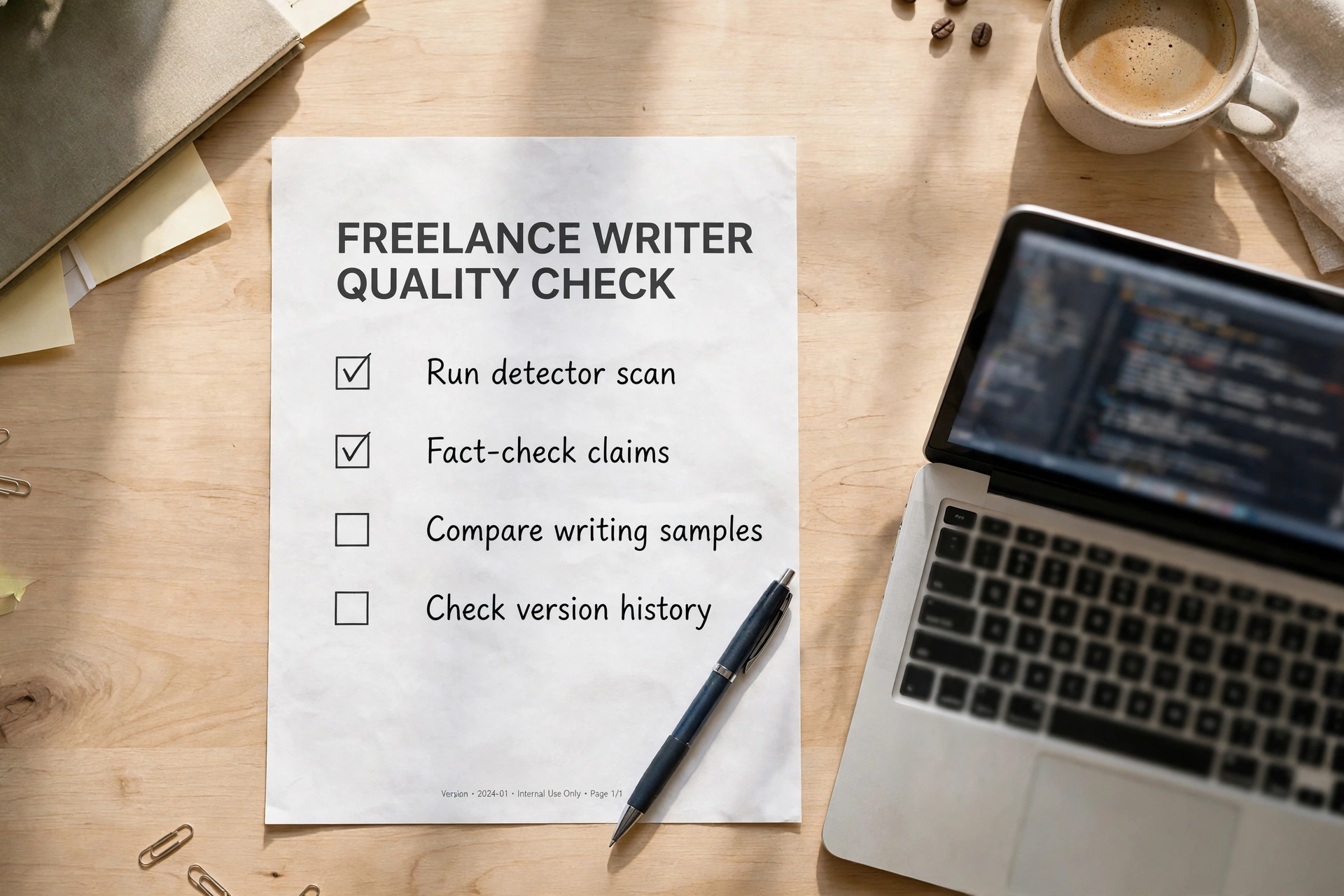
The short answer: you can get a strong signal that a freelance writer used AI — but no single check is proof. The approach that actually works is a layered one: run the draft through a detector, then back it up with process evidence (document version history, fact spot-checks, and a comparison with the writer’s earlier work). For screening at volume, Originality.ai is the best fit for content teams; for one-off spot checks, GPTZero’s free tier is enough. And never confront a writer on the basis of one detector score alone — false positives are real and documented.
Why site owners ask this question — and what the real risk is
You’re not paying for words; you’re paying for original thinking, research, and expertise. When a freelancer delivers AI-generated copy at human-writing rates, you’re overpaying for commodity text — and worse, you may be publishing invented facts, fabricated quotes, and generic advice that adds nothing to your site.
One fear you can set aside: Google does not penalize content simply because AI wrote it. Google’s position, unchanged since 2023, is that it rewards high-quality, helpful content “however it is produced” — and an Ahrefs analysis of one million top-ranking pages found that 5.3% of pages in positions 1–3 were 100% AI-generated. What Google punishes is low-quality, mass-produced content, whether a person or a machine wrote it. So the question isn’t “is this AI?” — it’s “is this worth publishing?” AI-written freelancer copy usually fails that test on substance long before it fails a detector. (See our guide: Does Google Penalize AI-Generated Content?)
Check 1: Run it through a detector — then interpret the score correctly
A detector is a good first screen and a terrible judge. Here’s what independent measurements actually say about how these tools perform on the text freelancers submit:
- The RAID benchmark (Dugan et al., ACL 2024) — a peer-reviewed evaluation across 11 AI generators and 8 domains — found Originality.ai averaging 85.0% accuracy overall and 96.7% on paraphrased AI text, ahead of GPTZero (66.5%) and ZeroGPT (65.5%).
- The Detection Drama benchmark (May 2026) measured independent false-positive rates around 2.1% for Originality.ai, ~4% for Turnitin, 5.8% for Copyleaks, 6–9.2% for GPTZero, and 11–14.7% for ZeroGPT — versus vendor claims of under 1% across the board.
- The edited-text blind spot: a December 2025 test of 100 samples found Copyleaks at 85%, Turnitin at 80%, and GPTZero at 70% accuracy on edited AI content. And a 2026 multi-source roundup (TextShift 500-sample benchmark, Humantext leaderboard, ProofreaderPro and AI-Tutor tests) reported that on humanized or heavily rewritten AI text, every major tool drops to roughly 3–8% detection.
The practical rule: a high AI score on a fresh draft is a strong signal of raw, unedited AI output; a low score proves nothing — it may mean human writing, or it may mean a writer who edited the AI draft well. That asymmetry shapes everything below. (Full data: How Accurate Are AI Detectors? What the 2026 Research Actually Says and Can AI Detectors Detect Paraphrased AI Text?)
Check 2: Look at the writing process, not just the finished file
Process evidence is harder to fake than prose. If your writer works in Google Docs, ask them to share the document with version history visible. Human writing typically shows gradual typing, deletions, and restructures over time; pasted AI output tends to arrive in large chunks in a single revision.
You can also ask for the outline before the draft, or a rough draft midway. A legitimate writer will have notes, discarded angles, and half-formed paragraphs. A writer who pasted a finished article from a chatbot will struggle to produce that trail. This check costs you nothing and is often more revealing than any detector.
Check 3: Read for AI fingerprints
AI-written drafts share tells that have nothing to do with detectors. Read the draft once specifically for these patterns:
- Confident emptiness: polished sentences that say nothing specific — no named people, no real examples, no numbers with sources.
- Generic scaffolding: “in today’s fast-paced world,” “moreover,” “in conclusion,” “it’s important to note that” — filler phrases that pad word count.
- Uniform rhythm: every paragraph roughly the same length, every section the same three-bullet structure.
- No personal texture: no anecdotes, no opinions, no first-hand observations — nothing a chatbot couldn’t have written.
None of these alone means AI wrote it. But a draft that shows all four was almost certainly not researched by a human.
Check 4: Spot-check facts, statistics, and quotes
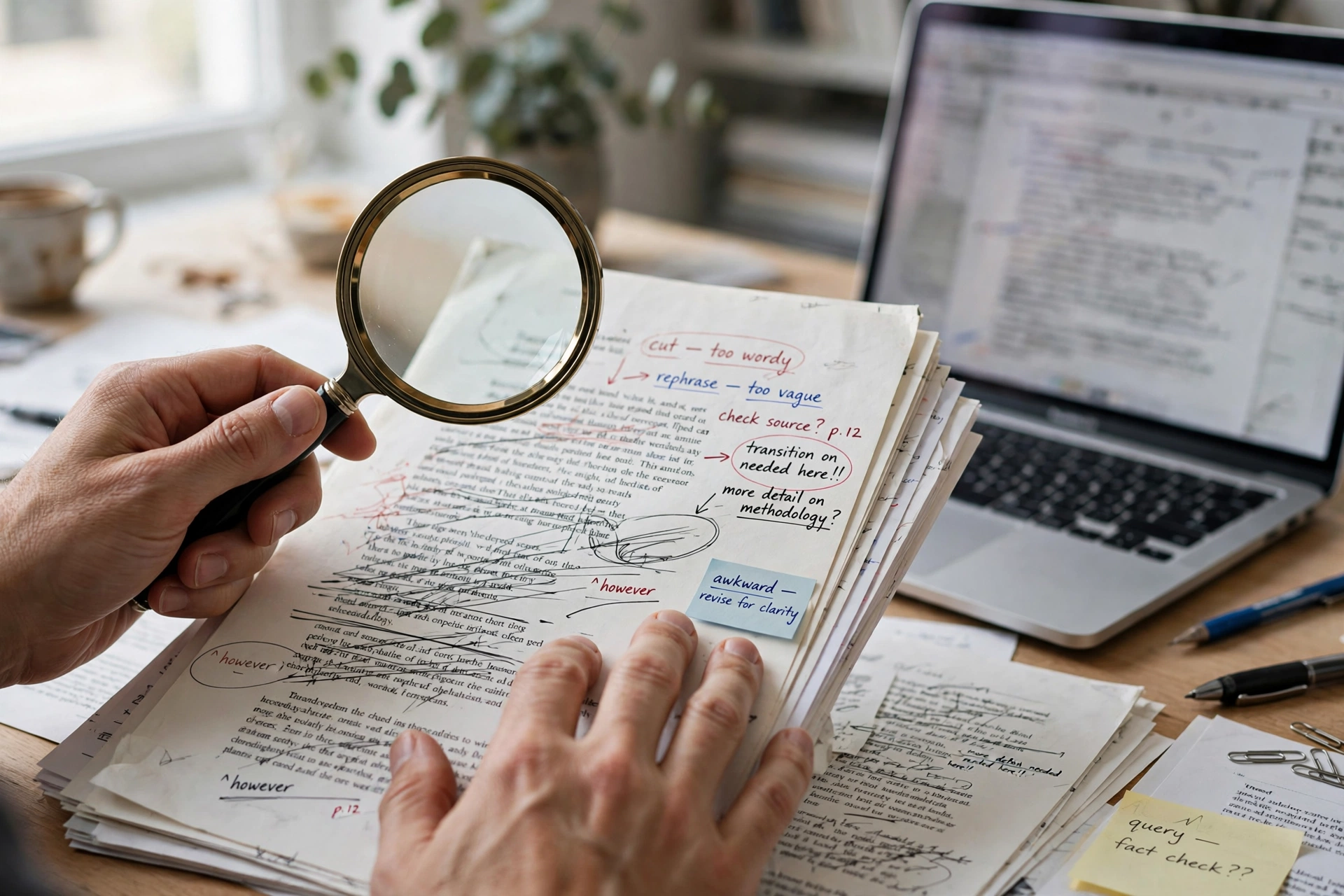
This is the check AI-written copy fails most embarrassingly. Language models confidently invent citations, statistics, and expert quotes. Pick two or three factual claims in the draft and verify them:
- Does the cited study exist? Search its title.
- Does the statistic appear in a real source?
- Is the quoted expert a real person who said that?
Fabricated references are the clearest evidence you’re dealing with AI output — human writers make errors, but they don’t invent entire papers. Ask the writer to provide source links for key claims as a standard part of every brief; writers who did the research will have them instantly.
Check 5: Compare the draft against the writer’s earlier work
A sudden voice change is a signal. If you’ve worked with a writer before, compare the new draft with their earlier pieces. A dramatic jump in output volume, a shift from opinionated writing to neutral filler, or a sudden disappearance of their usual quirks and examples all warrant a closer look. Keep a small archive of each writer’s past deliverables — it takes seconds to re-read an old piece for comparison.
Check 6: Ask the writer to explain their reasoning
Writers who did the work can talk about it; writers who pasted it often can’t. Pick the most complex or opinionated point in the draft and ask the writer to walk you through why they framed it that way, or what they’d cut if the piece had to be 30% shorter. This isn’t an interrogation — frame it as editorial feedback. A real writer will have immediate, specific answers. Someone who never engaged with the material will stall, deflect, or give you more generic filler.
Check 7: Screen before you hire, not just after delivery
The cheapest AI check is the one that prevents a bad hire. Give new writers a paid test piece with a twist AI handles poorly: ask for a first-hand comparison, an interview with someone in your industry, or an opinionated take that requires judgment. Generic prompts (“write 1,000 words on X”) invite generic AI output; specific, experience-based prompts reveal whether you’re hiring a thinker or a prompter.
What real user reviews complain about most
The most common complaint about AI detectors isn’t missed AI text — it’s false alarms on human writing. Three patterns show up repeatedly across user reviews, forums, and research:
- Non-native English writers get flagged disproportionately. Research summarized by Stanford HAI (Liang et al.) found that 61.22% of TOEFL essays by non-native English writers were classified as AI-generated across seven detectors. If your freelancer writes in their second language, a detector flag deserves extra skepticism, not less.
- Detectors disagree with each other constantly. Reddit threads are full of users reporting that the same draft scores 0% on one tool and 60% on another. Independent review roundups note that Originality.ai tends to flag aggressively — its sensitivity on paraphrased text comes with more false alarms than calmer tools.
- Free-tier results can be misleading by design. Some free versions hide the actual AI likelihood score or cap the text length, which means the “clean” result you saw may not reflect a full analysis.
The takeaway for site owners: when the stakes are high (a long-term writer relationship, a dismissal), run two different detectors and weigh process evidence more than scores. One number from one tool is gossip; two agreeing tools plus a thin version history is evidence. (Related reading: Falsely Accused of Using AI? Here’s What to Do Next)
A screening workflow that won’t burn your writer relationships
Screen drafts, don’t prosecute writers. The goal is quality control, not catching criminals. A workflow that works for content teams:
- Put your AI policy in the brief, upfront. State clearly whether AI assistance is allowed (outlining, grammar checks) and whether AI-written drafts are acceptable. Writers who know the rules rarely break them.
- Make source links a standard deliverable, alongside the draft.
- Use detectors as a triage step — high score triggers a human review, never an automatic accusation.
- Pay fair rates. The writers most likely to paste AI output are the ones paid too little to write properly. A fair rate buys you the one thing AI can’t fake: someone who actually cares about the piece.
What to do when a check flags a draft
Don’t open with an accusation — open with an edit request. “This section reads generic and the statistics need sources — can you add two real examples and link your sources?” gives an honest writer a clear path and gives a corner-cutting writer nowhere to hide. If the rewrite comes back with real specifics and verifiable sources, the problem is solved regardless of how the first draft was produced. If the pattern repeats across assignments despite feedback, end the relationship quietly. You don’t need to prove AI use to decide a writer isn’t meeting your bar.
Frequently Asked Questions
Can you prove a freelance writer used AI?
No — and that’s the wrong goal. AI detectors output probabilities, not proof, and every tool misses edited or humanized AI text. What you can do is build a screening process (detector + version history + fact checks + voice comparison) that reliably identifies low-effort, AI-pasted work. Judge the draft’s quality and verifiability, not its origin.
Which AI detector is best for checking outsourced content?
For teams screening freelancer copy at volume, Originality.ai is the strongest fit: it leads independent benchmarks on paraphrased text (96.7% in the RAID benchmark), includes plagiarism checking, and is built for publishing workflows. For occasional spot checks, GPTZero’s free tier (about 10,000 words per month) is enough. See our comparisons: Turnitin vs Originality.ai and What Is the Best Free AI Detector?
Will Google penalize my site if a freelancer delivers AI-written content?
No. Google rewards high-quality, helpful content “however it is produced” and does not penalize content for being AI-written. The real risk is publishing thin, generic, or factually wrong content — which is exactly what unedited AI freelancer copy tends to be. Fix the quality bar, not the tool.
How accurate are AI detectors on edited or paraphrased text?
Much less accurate than on raw AI output. The peer-reviewed RAID benchmark found accuracy collapsing on adversarial text for most tools, with Originality.ai the notable exception at 96.7%. A 2026 multi-source roundup reported that on humanized text, every major tool drops to roughly 3–8% detection. Always treat a low score as inconclusive.
Is it fair to check a writer’s work with an AI detector?
Yes, if the policy is disclosed upfront in your brief or contract — it’s standard quality control, like plagiarism checking. What isn’t fair is accusing a writer based on one score, given documented false-positive rates (especially for non-native English writers). Use detectors to trigger human review, never as a verdict.