
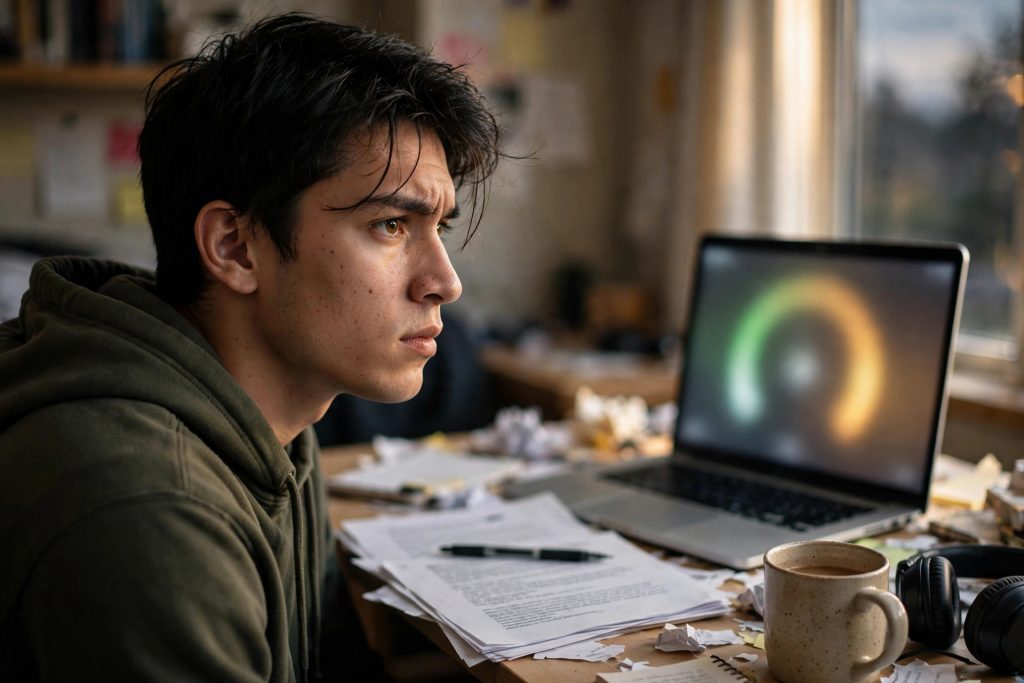
Open the free Scribbr AI detector and watch what loads. The input box, the word counter, the results panel — it all runs on QuillBot’s engine, served from a QuillBot subdomain, wearing Scribbr’s colors. Two brand names. One machine underneath.
That’s not a scandal; the two companies sit under the same corporate roof, and licensing an engine is ordinary software business. The problem is dumber. Every semester, students paste an essay into Scribbr, then “confirm” the result on QuillBot, and walk away believing two independent tools agreed. They didn’t. It’s the same witness, interviewed twice, in a different jacket. Keep that in your head and the rest of this tool’s behavior — what it catches, where its math quietly collapses — starts making sense.
Is Scribbr’s AI detector accurate?
In Scribbr’s own 12-tool comparison, the free detector scored 78% and the premium detector 84% — top marks in a test built from just 30 texts. Those numbers get quoted all over the internet, usually without the methodology attached. So attach it. Thirty texts. Each one 1,000 to 1,500 characters — call it 200 to 300 words, shorter than the introduction of most essays. Six categories: human writing, GPT-3.5, GPT-4, mixed human-AI, and two flavors of paraphrased output. Partial credit for near misses. The vendor chose the texts, ran the test, and sells the winner.
Here’s the thing: none of that makes the 78% fake. It makes it narrow. A score earned on 30 short, vendor-picked samples tells you how the tool behaves on 30 short, vendor-picked samples. Plot the perplexity curves of 100 human essays against 100 machine essays and the distributions overlap like roof shingles — a fat gray zone where any threshold the vendor picks is wrong for somebody. Scribbr picked its threshold on a small, clean dataset. Your thesis chapter is neither.
Three questions dismantle any detector’s accuracy claim, this one included. How many test texts? Who chose them? And where is the false positive rate, printed in the same font size as the accuracy number? Scribbr, to its credit, publishes the first two answers and recorded zero false positives in its test. Zero out of a handful of human samples. Statisticians have a word for that sample size, and the word is “anecdote.”
Where the engine actually breaks: blended text
The text students actually submit is rarely pure machine output. It’s a draft with AI scaffolding, human edits, a paraphrased paragraph, two sentences rewritten at 1 a.m. That blended category is where this detector bleeds. In Scribbr’s own comparison, even the premium version caught only 60% of the mixed and paraphrased samples. Four in ten slipped through the best tool Scribbr sells.
Rival vendor Originality.ai ran Scribbr against its own samples — discount the source, it’s a competitor — and the pattern was weirder than a simple miss rate. A ChatGPT cover letter: 95% detected. A ChatGPT blog post: 0%. Product description: 0%. Same engine, same model family, wildly different outcomes depending on register. Formal, structured prose gets read carefully. Casual, chatty prose walks straight past. We saw the same shape when we dug into whether detectors can catch paraphrased AI text at all — the rewrite doesn’t even have to be good, it just has to change the rhythm.
Run one borderline text through six different detectors and you’ll collect scores from 8% to 94%. That’s not measurement error around a true value. There is no true value. There’s a probability model with opinions, and Scribbr’s opinion happens to be QuillBot’s.
The truth about Scribbr false positives
Scribbr recorded zero false positives in its own test — and the writers who get flagged anyway are the ones whose natural prose is predictable: careful non-native writers, formulaic lab reports, anyone trained to write plainly. The engine doesn’t detect authorship. It detects how surprising your next word is. Write English the way textbooks teach it — clean transitions, standard collocations, no slang, no weird detours — and your perplexity profile slides toward the machine end of the chart through no fault of your own.
If an institution flags your work off a score like this, the appeal that works is not “your tool is broken.” It’s a paper trail plus one precise argument. The paper trail: drafts, version history, notes, anything timestamped that shows the text growing over days instead of arriving in one paste. The argument: the detector confuses simple, correct English with generated English, and it cannot separate the two, because statistically they look alike. Ask which specific sentences triggered the flag and request a human read of those sentences in context. Our guide on what to do if you’re falsely accused of using AI walks through the full sequence. Scores end arguments only when nobody asks how the score was built.
Test the 1,200-word trap yourself
The free tool caps each check at 1,200 words, which creates a failure mode nobody warns students about. Try this on your own essay before trusting any single score. Run the introduction alone, maybe 150 words. Then 400. Then the full section. Watch the verdict swing. Perplexity is a statistical estimate; at 150 words the estimate is built on a handful of sentences, and a detector that sounds confident down there is doing astrology with better fonts.
Chunking a thesis makes it worse. A 20,000-word dissertation becomes roughly seventeen separate checks, seventeen local verdicts, and students average them in their heads as if that meant something. It doesn’t. One flagged chunk in seventeen is a paragraph to re-read, not a document-level probability. Split at section breaks, never mid-argument, and drop quotations and reference lists before you paste — you’re testing your prose, not your bibliography’s.
Before you pay for the premium detector
The premium detector rides inside Scribbr’s plagiarism checker at $19.95 per document up to 7,500 words — you’re buying a bundle, not a sharper crystal ball. Scribbr’s own test puts the gap at six points, 84 against 78, on those same 30 texts. What the money really buys is logistics: no slicing your document into 1,200-word pieces, and a plagiarism report in the same pass. For one chapter, the free tool split at section breaks does the same job for zero dollars. For a full dissertation two days before submission, the bundle is honestly priced against your panic.
The narrow pocket where Scribbr earns its keep: a student, pre-submission, checking formal academic prose for accidental AI-shaped passages. Free, no account, paragraph-level highlights. Outside that pocket it fades fast — bloggers checking conversational copy are testing in the register the engine barely sees, and anyone waving a percentage as evidence against another person is misusing a screening tool as a verdict. It sits in the same tier as the other free AI detectors worth using: fine as a first pass, disqualifying as a final word.
Run it if it’s free. Just stop calling the second run a second opinion.
Related AI Content Guides
Go deeper on AI content creation and detection.
AI for Creators: Writing, Art & Video Tool Reviews
Complete AI production framework — scripts, images, video pipeline
AI Filmmaking Master Class
Generative filmmaking workflows, ethics, and distribution
The Ultimate AI Prompt Handbook — Creators Edition
Copy-paste prompt library for social media content creation
This site contains affiliate links. We may earn a commission on qualifying purchases.
FAQ
Is Scribbr’s AI detector the same as QuillBot’s?
For the free version, effectively yes. Scribbr’s free detector runs on QuillBot’s engine and interface, and Scribbr’s own comparison gave both tools the identical score — 78% — on the same 30 test texts. Checking your text on both is not a second opinion.
How accurate is Scribbr’s free AI detector?
Scribbr’s own test scored it at 78%, with the premium version at 84%. That test used 30 short texts chosen by Scribbr, and independent tests show accuracy swings hard by writing style: formal AI text is caught reliably, while casual blog-style output has scored as low as 0% detected.
Can I check a whole thesis with Scribbr for free?
Not in one pass. The free detector accepts up to 1,200 words per check and unlimited checks, so a long document has to be split into sections. Split at section breaks, remove quotations and references first, and treat each result as a local reading rather than a whole-document verdict.
Does Scribbr flag human writing as AI?
It recorded no false positives in Scribbr’s own small test, but the risk profile is well known: writing with naturally predictable word choices — plain, textbook-style English, common for non-native writers and technical reports — is what this type of engine flags. A flag is a prompt for human review, not proof of anything.